
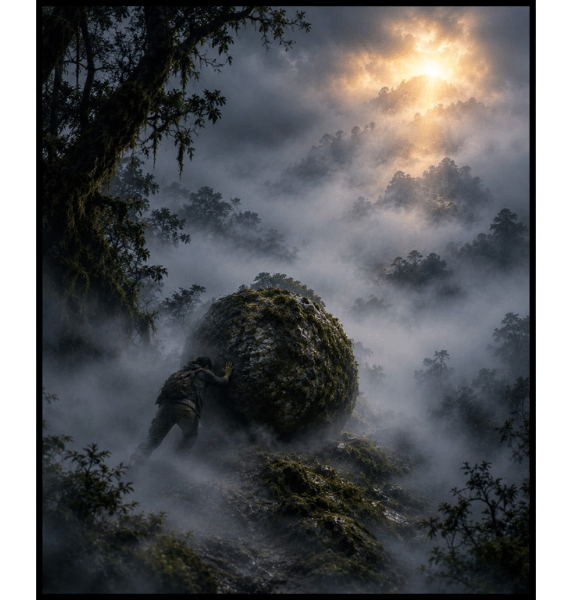
Hogsback is beautiful. We know this. We live among the forests, the mist, the waterfalls and the mountains.
But there is another side to living here. One that cannot be photographed.
There are people who arrive on this mountain carrying the remains of lives that have already broken them. They come desperately needing somewhere to breathe, somewhere to recover, somewhere to begin again. Perhaps they believe they have finally escaped survival mode.
And then life here begins. For some, the sacrifices are chosen. They want a simpler life and accept what comes with it. For others, there is no real choice.
Modern conveniences disappear. Healthcare becomes difficult to access. Groceries and familiar necessities become harder to find. Money becomes tighter. Housing can be inadequate. Work can be uncertain. Distance turns ordinary needs into major obstacles.
And slowly, something deeper can happen. A person can begin to lose control over their own life.
There is a profound difference between choosing a simple life and being unable to change the life you are living.
Imagine knowing you need to leave, but having nowhere affordable to go. Knowing you need medical care, but knowing that care is far away. Knowing your circumstances are damaging you, but being unable to change them. Knowing your family needs a different future, while the only realistic way to provide it, depends on something completely outside your control.
A property selling. Money becoming available. The right opportunity appearing. A door finally opening.
And while you wait, life does not wait with you.
The clock keeps moving. For someone already carrying trauma, this can become an extraordinary psychological burden. They came here thinking, “I survived that. Now I can heal.” Instead, they find themselves surviving something else. Years of survival can change a person.
Constant vigilance can become normal. Trust can become difficult. Withdrawal can feel safer than connection. Exhaustion becomes ordinary. A person may become angry, defensive, numb, suspicious or overwhelmed.
Eventually, they may barely resemble the person who first arrived.
Not because they were weak. Because they adapted to what life kept demanding of them.
And perhaps this is where we need to look more carefully at one another. We see behaviour, but rarely see the history behind it. We see the angry person, but not the years of exhaustion. We see the withdrawn person, but not the loneliness. We see the difficult person, but not the possibility that their reserves have been completely depleted.
None of this excuses hurting others. But it should make us think before we judge.
Because conflict, rejection, bullying, rumours and cruelty do not land on empty spaces. They land on human beings who may already be carrying far more than we know. Sometimes a person is not simply struggling with today. They are carrying yesterday, while desperately trying to protect tomorrow.
And sometimes the pressure becomes terrifyingly simple:
What if medically your time is running out, and so is your time to save your family?
That is a burden few people around you will ever see.
You are not only trying to survive the present. You are trying to build a way out for the people you love, while wondering whether you have enough time, health, money or strength to make it happen.
This is what being trapped can feel like. Not merely wanting to leave. Knowing you need to leave, while having no way to make the leaving happen.
We cannot explain suicide by one event, one person or one community. Human suffering is far too complex for that. But isolation, loss, financial hardship, conflict and disconnection can add to an already overwhelming burden, while connection, belonging and support can help carry it.
And perhaps that is what we need to remember. Some people came to Hogsback to heal. Some came because they had nowhere else to go. Some have been surviving here for so long that survival has become part of who they are.
We cannot remove every hardship from this mountain. But we can stop becoming another hardship for one another. Listen before judging. Think before speaking. Notice when someone is withdrawing. Make room for people to belong. Because perhaps the greatest gift we can give someone who has lost control of so much of their life is the knowledge that they are not completely alone.
The mountain may be beautiful. But the people living on it are human. And every one of them is carrying something we cannot see. And yet, perhaps that is not where our story has to end.
Because this mountain, for all its hardships, still holds something extraordinary. Hope.
It lives in the morning mist, in the sound of water moving through the forest, in a fire on a cold winter night, in birdsong, in colour returning after rain, and in the simple kindness of one person helping another.
Perhaps we should never lose sight of that. Life can become unbearably difficult. Circumstances can change us. Sometimes we may feel trapped in a chapter we never chose. But chapters can change. Doors can open. People can help.
And sometimes, when everything feels dark, the mountain itself reminds us that beauty can still exist alongside pain. So hold on to hope. For yourself. For your family. For the person standing beside you who may be struggling silently.
Because even on the darkest days, there is still another morning waiting beyond the mist.
– The Seeker of Magic