
Finding the Forest’s Last Parrots: Exploration and the Cape Parrot Project
Before the Wild Bird Trust could conserve the Cape Parrot, it had to find it.
That is easy to forget. The Cape Parrot Project began in 2009 here in Hogsback, when Dr Steve Boyes went looking for a bird that most South Africans had never seen and few scientists had properly counted. South Africa’s only endemic parrot survives in scattered patches of Afromontane mistbelt forest across the Eastern Cape, KwaZulu-Natal and Limpopo. No single population holds more than a few hundred birds. Finding them meant walking into forest that had barely been surveyed.
That is the exploration at the heart of this project, and it has never really stopped.
Fieldwork in unmapped forest
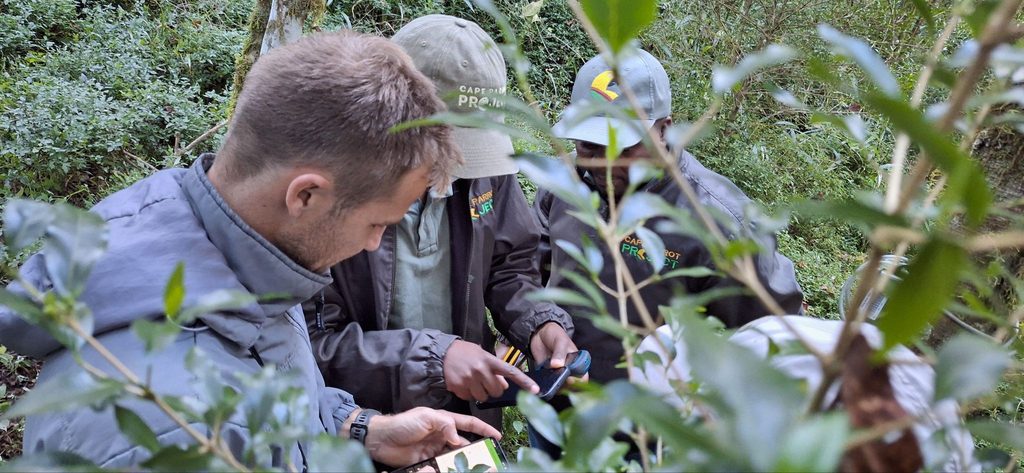
Cape Parrots nest in cavities of old dead or dying trees, known as snags – primarily yellowwood trees, which logging has left in short supply. To protect what remains of the habitat of these trees, the team first has to know where it is. Field teams commenced forest monitoring work in 2024 and trek into remote forest patches to see what areas could support Cape Parrots, looking for potentials, recording trees the birds depend on for food and shelter, and checking on forest quality.
Much of this forest has never been mapped in detail. CPP has helped build spatial habitat maps that show where forest quality and breeding potential are highest, and which structural and topographical features matter most to the birds. This is exploration done with GPS units and satellite imagery as much as with binoculars: charting ground that conservation planning has, until now, had to guess at.
Around Hogsback, the species team’s field surveys have shown that Cape Parrots range well beyond their mistbelt forest. Once thought to feed almost exclusively on yellowwood kernels, the birds have been recorded taking fruit and nuts from as many as 36 different tree species, and flying up to 80 kilometres from their home forest to reach them, including pecan orchards on nearby farms. Tracking those movements, and working out what they mean for where the birds need protecting, is its own kind of exploration: following the parrots rather than just the forest.
Since 2022, that same approach has carried the project north, into Limpopo, home to a small and separate population of Cape Parrots that has had far less attention than the birds around Hogsback and the KwaZulu-Natal escarpment. What is already clear is that it means the same job all over again: locating forest patches, identifying nesting and feeding trees, and building an understanding of a population that has, until now, been little studied.
Why this matters beyond the parrot?
None of this is exploration for its own sake. Every survey feeds a very practical goal: knowing enough about the Cape Parrot’s habitat to restore it well. Since 2009, that knowledge has guided tree planting and forest restoration around Hogsback, much of it carried out by community members employed to do the work.
This is also where the Cape Parrot Project connects to the wider identity of Wild Bird Trust. The same interest that sent Steve Boyes into the Hogsback forests in 2009 later took Wild Bird Trust into the Okavango, mapping some of the least-known waterways in Africa with the National Geographic Society. Different landscapes, same approach: go and look properly, involve the people who live there, and let what you find shape the conservation that follows.
Still exploring, further afield
That approach has not stood still. The National Geographic Okavango Wilderness Project has carried out dozens of expeditions since 2015, from annual crossings of the Delta to treks across the wider river basin, building a scientific baseline for a region that had barely been studied before.
More recently, The Wilderness Project has taken the same method further along the continent’s water towers. Under the Great Spine of Africa series, teams have paddled and walked the length of rivers few scientists had ever surveyed source to end, from the Zambezi and the Cassai in Angola to stretches of the Congo and the Nile basin. The ambition is large: to document, in detail, watersheds across roughly 1.2 million square kilometres of largely unprotected African wilderness, working alongside local communities, researchers and governments along the way.
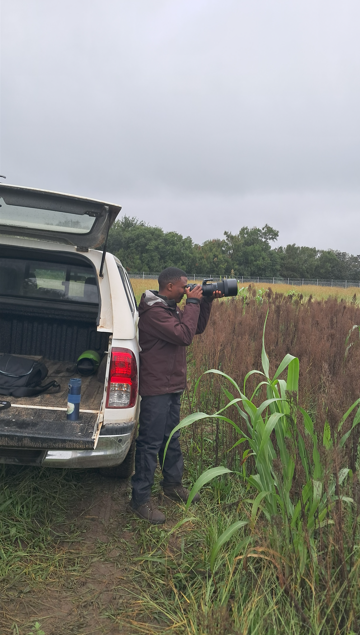
Photo: Obakeng Pule – Species Research Assistant – Hogsback out looking for parrots.
Different rivers, different teams, but the same starting point as Hogsback in 2009: you cannot protect what you have not first gone to see.
The Cape Parrot is easy to miss. Its forests are steep, remote, and often overlooked. Wild Bird Trust’s exploration work exists to make sure that neither the bird nor its habitat stays unseen.
– Susan Wishart, CPP
For More Information, follow our Socials:
https://www.facebook.com/capeparrotproject
https://www.instagram.com/capeparrotproject
https://www.youtube.com/channel/UCK13Mty-w3USNHtOs1OEpdQ
https://www.linkedin.com/company/cape-parrot-project
Contact: Susan Wishart (Project Manager) susan@wildbirdtrust.com 067 416 7219