

Local Outrage Grows
These predators are silent, they lie in wait…
these predators are violent, they don’t discriminate.
Made from fencing wire, brake cables or nylon cord…
to a fixed object, these murderous loops stay anchored.
Most Hogsback locals have a scary snare story… or know someone who does. From the brutally fatal all the way to; “that was close!”… these stories, especially in ‘Dogsback’ are ripping holes in our relationship with nature itself.
Not too long ago, before we had to bushwack through non secure, non-permit-restricted areas… we walked our dogs in safer spaces… in recent weeks, the amount of snares found on private property, points to the reality that… even our own back yards are no longer safe.
While historically set for bushmeat (inyama yomoya) or localized crop protection against wild pigs and porcupines, modern wire snaring bears no resemblance to traditional, regulated hunting (Ukuzingela). Traditional leaders and elders recognize unmonitored wire snares for what they are… non-selective, highly destructive poaching.
The Legal Reality:
Under South African law:
- Animals Protection Act (Act 71 of 1962): Inflicting unnecessary suffering on domestic or wild animals carries severe criminal penalties, including fines and imprisonment.
- Provincial Nature Conservation Legislation: Wire snares are explicitly banned as a hunting method under Eastern Cape environmental regulations and the National Environmental Management: Biodiversity Act (NEMBA).
- Criminal Offenses: Placing traps on private or communal property without explicit authorization constitutes trespassing, illegal hunting, and property damage.
Safe Deactivation and Removal:
- Inspect the Immediate Area: Scan for secondary traps or ground triggers before stepping into the brush.
- Neutralize the Anchor: Cut the loop with heavy-duty wire cutters or unwind the anchor wire directly from the post or tree.
- Extract the Material: Remove all wire from the area entirely; disabling a snare on-site leaves raw materials for poachers to rebuild immediately.
- Document and Log: Record exact GPS coordinates, date, time, and photographic evidence before disturbance.
Community member’s plea
“Please make it known to the community that this action is absolutely not acceptable.
On Sat night, early hours of Sun, a dog was caught in a snare. And it’s barking and howling went on for hours.. Keeping many awake and upset, till a group of volunteers found the dog in a snare.. Still alive at 0300am. This is the most cruel way of trying to catch buck even but most of all pet dogs are getting into them. This is an illegal action.. And not allowed. Besides the fact that people are trespassing on private property.. Other residents have also found snares recently… And are terribly upset. Dogs have been found with snares around them too.. I’m asking that people stop this setting of snares, please.”
– Lynden Wittstock
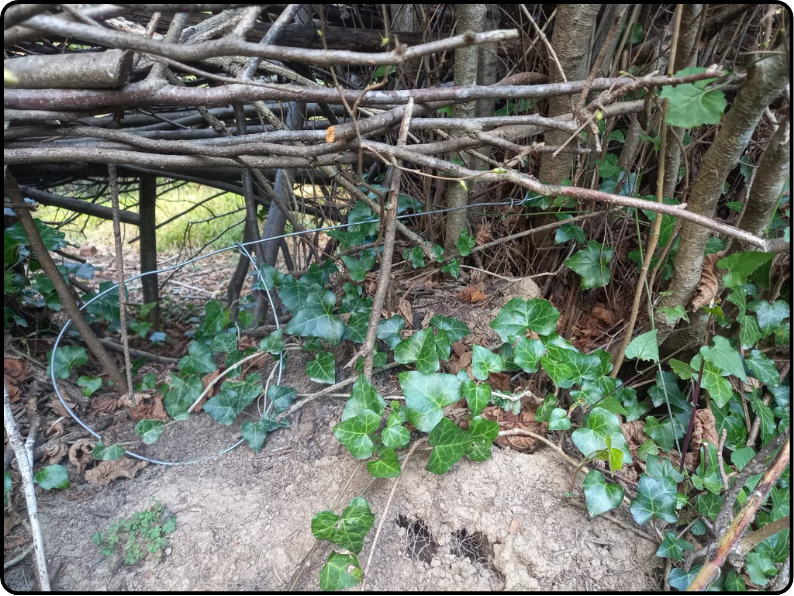
Snares are usually placed across paths that animals already use, with the wire loop positioned at about head or body height. Sometimes brushwood is used around the sides to narrow the animal’s route and guide it towards the loop. They can turn up along established game trails, forest edges, routes to water, gaps in fences and increasingly… on private property. Which is where this becomes particularly alarming for this community and our dogs.
What can WE do:
Well, firstly, stop assuming that somebody else will deal with it. Follow the Safe Deactivation and Removal steps above. (And look after your animals guys! Walk them so they don’t need to go walk themselves. Fix your fences, check them regularly.)
And report, report report. You don’t need to know who put the snare there, in order for you to report it. You don’t need a name, an address or a confession. You can report what you actually know (there is a snare here; this is where it is; this is what I found).
If you have information about who may be responsible, pass that information on, yes, pass it on, but please don’t turn suspicion into accusation. Let the authorities investigate.
Report every incident, I cannot say this enough. One snare might be dismissed as an isolated incident. Ten reports showing the same pattern, in the same area, over time, are much harder to ignore. Keep your reference numbers. Take photographs. Share information responsibly. If your dog has been caught, injured or killed, report that too.
Maybe (and I can hardly believe I am saying this), but maybe we need a task team, a group that collects all this data in one spot. Who tackles area by area, snare clearing days etc. And perhaps we need to start asking a slightly bigger question.
If snares have been a problem here for years, how much information have we actually collected about them? Where are they being found? How often? What are they catching? And what happens after we report them?
How many incidents have been formally reported? … According to Col. Masiwa, Hogsback SAPS; confirmed no snare related dockets opened or reported in the last 12 months. We absolutely need to start reporting these incidents to SAPS, nothing changes if we don’t start there.
This isn’t about starting a witch hunt. It’s about making the problem visible enough that somebody has to deal with it.
WHO TO CONTACT:
SAPS Hogsback
045 962 1030 / 067 598 2160 / 072 830 6738
For criminal complaints, opening a docket and obtaining an official case/reference number.
SAPS Crime Stop
08600 10111
Or use the MySAPS App to submit a tip-off. This can be used for information about suspected snare setting or bushmeat activity.
Hogsback CPF (Community Police Forum)
Report recurring snare activity and local patterns to the CPF so that the issue can be raised as a community safety concern and followed up locally.
SPCA East London & Amathole
043 745 1441 | gm@elspca.org.za
For animal cruelty investigations, emergency rescue and inspectorate assistance.
King William’s Town / Qonce SPCA
043 643 6030
For local animal rescue and treatment coordination.
Eastern Cape Parks & Tourism Agency (ECPTA)
043 705 4400 | info@ecpta.co.za
For illegal snaring and environmental crime involving state or protected land, and matters falling under provincial conservation legislation.
NSPCA National – Specialist Protection Unit
011 907 3590 | nspca@nspca.co.za
For escalating animal-cruelty matters, particularly where local responses are inadequate or a recurring systemic problem needs attention.
So, if you find one, don’t just step over it and carry on walking. Photograph it. Record it. Report it.